
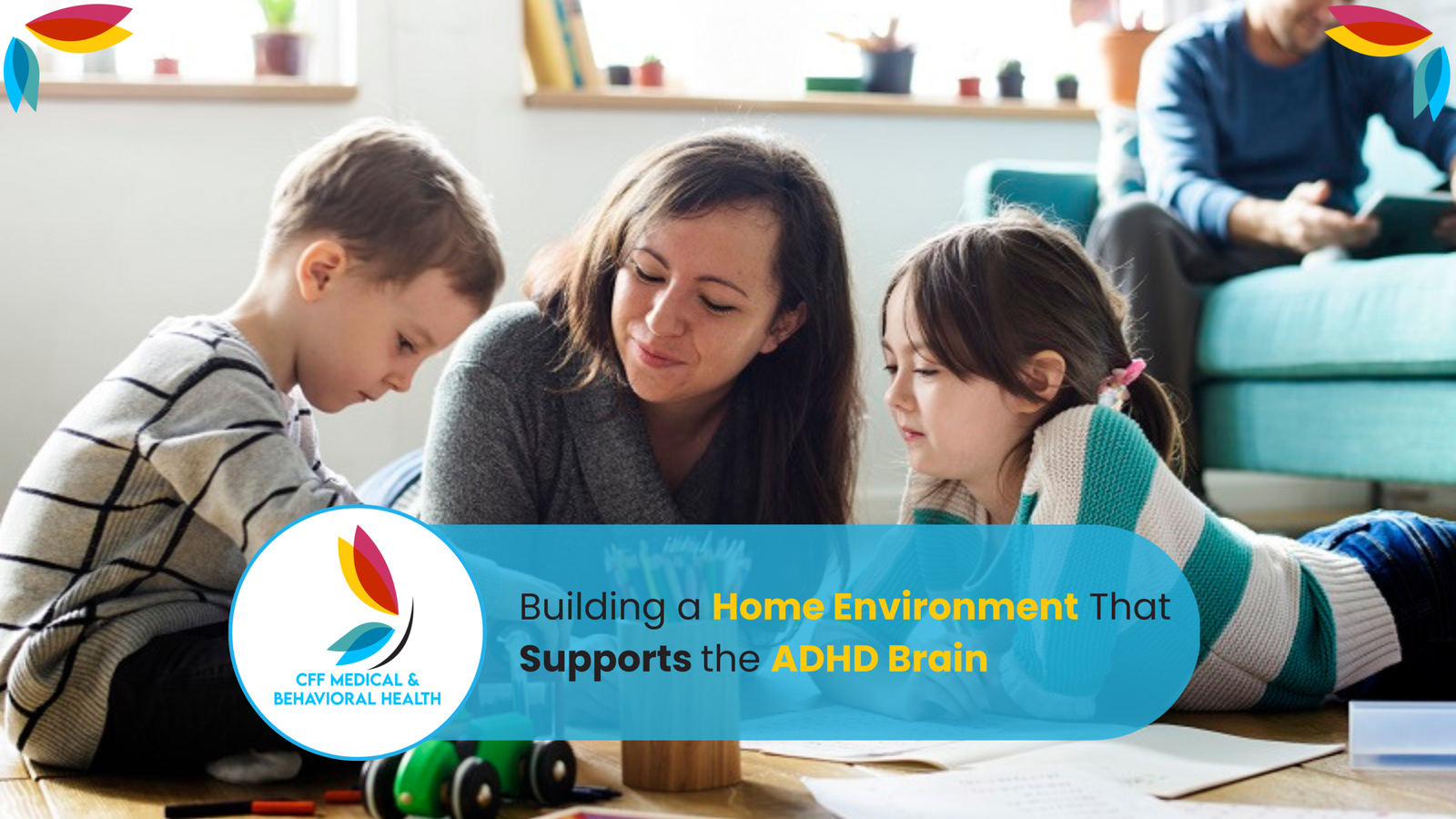
The world outside the front door isn’t designed for ADHD. But the space inside it can be. Here’s how to set up your home so it works with your brain instead of constantly fighting it.
There’s a version of ADHD management advice that makes it sound like a willpower problem. Try harder. Be more disciplined. Make a better to-do list. And if you have ADHD, you know exactly how well that goes.
The ADHD brain isn’t lazy. It’s wired differently. It has a hard time filtering distraction, keeping tasks in working memory and switching attention on demand.
That wiring is not altered by any amount of willpower. But what about the environment around that brain? That you can actually do something about.
This does not mean having a well-organized house.
This is related to making certain, specific alterations to your physical surroundings in such a way that the everyday frustrations of living with ADHD is reduced to some degree.
Simple steps that minimize the amount of effort you brain needs to exert in order to make it through the day.
First, Understand What the ADHD Brain Actually Needs From a Space
It is also important to know what you are really looking to solve before rearranging furniture or purchasing organizers.
ADHD brings with it certain challenges that manifest within the home on a daily basis.
Working memory gaps
The scratchpad of the mind that can temporarily hold information as you use it. In attention deficit hyperactivity disorder, it is not reliable. You enter a room and do not remember the reason.
You set something down and have no idea where it went thirty seconds later.
You have a plan in your head, get distracted, and the plan evaporates.
A well-designed home environment compensates for working memory by making information visible and physical rather than relying on the brain to hold it.
Out of sight literally translates to out of mind to many people with ADHD. The idea is to create a place where one does not need to recall anything.
Difficulty with transitions
Transiting between activities or tasks is actually more difficult with ADHD.
The brain becomes stagnant in whatever it is doing and does not want to change.
Shifts between contexts can be facilitated by physical spaces providing visual and spatial markers that indicate a shift.
A room that is not used in any other way. A corner that doesn’t contain a screen. The space informs the brain of which mode it is in.
Sensitivity to stimulation
Compared to the brain of neurotypical people, ADHD brains are more susceptible to sensory input.
Clutter, ambient noise, visual noise, uncomfortable textiles, flickering lights: all of that is competing to get your attention, which isn’t going to seem like such a big deal to someone without ADHD but is actually a source of strain to someone with the condition.
This does not imply depersonalizing your house or rendering it comfortable.
It is being mindful of what stimuli you are bringing into your environment, and lessening those stimuli that drain you rather than enliven you.
The Entryway: Where ADHD Mornings Win or Lose
Mornings are a tricky part of the day especially when you have ADHD.
Not due to you being lazy or disorganized by nature, but because morning routines demand precisely the types of tasks that the ADHD brain is not very good at processing: sequential thinking, self-initiation, the ability to remember several steps and transitioning under time pressure.
The access point is a point of leverage. Some little organization, here, can help to avoid the five minutes of hysteria when the key is lost, the lunch forgotten, the wrong pair of shoes, the bag that was surely just here yesterday.
An ADHD-friendly entryway
- One hook per person, at eye level, for bags and keys. Not a hook rack with six hooks where things end up stacked on top of each other. One specific hook. One specific spot. The brain needs to know exactly where to look without making a decision
- A small tray or dish, fixed and always in the same place. Wallet, keys, transit card, whatever leaves the house daily. The rule is simple: if it’s going out tomorrow, it lives in the tray tonight
- A visible to-do or checklist near the door. Not in a notebook. On the wall or on a whiteboard at eye height. “Did I take my medication? Do I have my phone charger?” Whatever matters for your specific morning, made impossible to miss on the way out
- Shoes belong here, not in the bedroom. Every time shoes have to be hunted down, that’s a transition being disrupted. Eliminate it
The entryway system only works if it’s used consistently.
The first week requires some conscious effort. After that, the habit tends to stick because the payoff, not losing fifteen minutes every morning looking for things, is immediate and obvious.
The Workspace: Where Focus Either Happens or Doesn’t
A lot of ADHD advice about workspaces focuses on eliminating clutter. That’s part of it. But the bigger thing is context.
The ADHD brain is highly context-dependent.
Where you work signals what mode you’re in, and when the workspace is used for work and also for gaming and also for watching videos and also for eating and also for phone scrolling, the brain doesn’t know what it’s supposed to be doing when you sit down.
Setting up a space that says ‘this is where work happens’
- Dedicate a specific spot for focused work, even if it’s small. It doesn’t have to be a full home office. A corner of a table works. What matters is that you use it only for work or study, and use other spaces for everything else. Over time, sitting there becomes a cue
- Clear the desk surface except for what you’re working on right now. Everything else goes in a drawer, a bin, or off the desk entirely. Visual clutter is a direct competitor for attention in an ADHD brain. This isn’t about neatness for its own sake. It’s about reducing the number of things your eyes can land on
- Use noise as a tool, not background annoyance. Many people with ADHD actually focus better with some kind of sound than in complete silence. Complete silence allows every small noise to become a distraction. Low, consistent background sound, whether that’s music without lyrics, brown noise, or ambient sound, can help the brain settle. Figure out what works for you and make it easy to turn on
- Keep your phone physically out of reach during focused work. Not just face down. In a different room, or in a drawer. Every ADHD brain already knows what happens when the phone is within reach
- Use a timer visibly. A physical timer on the desk, not a phone timer, is one of the most practical ADHD focus tools there is. The ADHD brain struggles with time perception. Seeing time physically pass gives you external feedback that your brain’s internal clock usually doesn’t provide
The goal isn’t a workspace that looks productive. It’s a workspace that makes starting easier and staying on task less of a battle.
Storage and Organization: Make It Impossible to Lose Things
The conventional advice about home organization assumes a brain that remembers where it put things and has the executive function to maintain complex systems. That’s not the ADHD brain. Systems that require multiple steps, perfect consistency, or a lot of mental overhead will fall apart within a week.
The organizing principle for ADHD homes is different. Make things visible. Make them easy to put back. Reduce the number of decisions required.
Visibility over containment
Closed storage, drawers, cabinets, boxes with lids, tends to make things disappear for people with ADHD. Open shelving, clear bins, and open trays make things visible without requiring you to remember where you put them. You can see it, so you know it exists.
- Use clear bins or open baskets wherever possible. Labeled is fine, but even without labels, being able to see the contents reduces the cognitive load of finding things
- Create ‘landing zones’ for categories of items. A spot for paperwork that needs attention. A spot for things that belong in other rooms. A spot for things that need to go back to other people. The categories matter less than having a consistent physical place for them
- Apply the one-touch rule where you can. If an item requires two or more steps to put away, it often won’t get put away at all. Reduce the friction: hooks instead of hangers, open bins instead of lidded boxes, a tray by the door instead of a shelf in the closet
- Accept that some surfaces will collect things. Instead of fighting it, designate one surface as the ‘landing pile’ and deal with it once a week. Trying to maintain zero-clutter everywhere is a setup for constant failure. One intentional pile is better than piles everywhere
Medication management at home
This one is specific and worth addressing directly. Forgetting to take medication is extremely common with ADHD, and it’s not because the medication doesn’t matter to you. It’s because out of sight, out of mind applies to pills just as much as it applies to keys.
- Keep medication visible and tied to something you already do every morning. Next to the coffee maker, next to the toothbrush, next to whatever object you interact with at the same time every day. The habit stacking helps the reminder stick
- Use a weekly pill organizer. Not because it looks organized, but because it makes it immediately obvious whether you’ve taken today’s dose or not. No trying to remember. You can see it
- Set a phone alarm if visual reminders alone aren’t reliable. Label the alarm clearly so it’s immediately obvious what it’s for when it goes off
The Bedroom: Sleep Is Not Optional for the ADHD Brain
ADHD and sleep problems have a complicated relationship. Stimulant medications can delay sleep onset. Hyperactive thoughts at night make it hard to wind down. The natural tendency toward delayed sleep phase means many people with ADHD are genuinely not tired until late. And then they’re exhausted and emotionally dysregulated the next day, which makes every ADHD symptom worse.
The bedroom environment can’t solve all of that, but it can help.
Making the bedroom actually restful
- Keep the bedroom free of work materials. Laptops, unfinished projects, and paperwork in the bedroom blur the context of the space. The brain needs to know the bedroom is for rest, not for tasks
- Charge your phone outside the bedroom. Or at minimum across the room, out of arm’s reach from the bed. The phone near the bed and the ADHD brain before sleep is a combination that reliably adds one to two hours of awake time
- Use blackout curtains if early light wakes you. Light is one of the primary signals the body uses to end sleep. If you’re a late sleeper who needs to sleep past sunrise, blocking that signal matters
- Create a simple, consistent wind-down sequence. Not an elaborate routine. Just two or three things in the same order every night: dim the lights, make tea, read something low-stakes, whatever works. The consistency is the signal. Over time, the sequence itself triggers the body’s shift toward sleep
- Weighted blankets work for some people with ADHD. Not everyone, but the deep pressure input can reduce physical restlessness and help the body settle. Worth trying if nighttime fidgeting is a regular issue
Making the Whole House Work: Systems Over Perfection
When you attempt to reform everything at once, you reform nothing. ADHD renders extensive overhauling to be truly difficult to uphold.
The more correct way is to choose one area, one problem you wish to solve and create the smallest possible system that satisfies it.
Then leave it till it turns automatic then add the other stuff.
Some principles that bind the whole thing together
- Design the way you do, the way you really behave, not the way you would like to behave. Get open shelving, in the event that you never close the doors of cabinets. When you always drop your coat on the chair rather than the hook, then bring the hook near the chair. Get out of a fight with the pattern and reform the world around it.
- Use visual reminders aggressively. Whiteboards, sticky notes, printed checklists on walls, alarms labeled with exactly what they’re reminding you to do. The ADHD brain can’t be relied on to hold information. The environment has to hold it instead
- Build in reset moments, not endless maintenance. A five-minute “reset” at the end of each day or week to return things to their spots is more realistic than trying to maintain perfect order in real time
- Involve the people you live with. An ADHD-friendly home environment works better when everyone in the household understands the reasoning. When family members know why things are set up a certain way, they’re more likely to support the system rather than accidentally undermine it
- Give yourself permission to have a different kind of home. Other people’s homes might have decorative bowls and neatly arranged shelves with no visible labels. That’s fine for them. Your home needs to work for your brain, and those two things might not look the same
When the Environment Isn’t Enough
An improved house arrangement really works. But it’s not treatment. In most cases, ADHD environmental changes minimise friction and help people with ADHD live more easily in every-day life, but the underlying symptoms, the impulsivity, the emotional dysregulation, the problems of focus, time blindness, still require more direct assistance.
When you or some member of your family continue to struggle greatly at home, at work or at school even when you are trying to develop better systems, that is not a failure of effort. It is an
indicator that the environmental aspect, though useful, is not covering the entire picture.
Signs that clinical support would help
- ADHD symptoms are significantly affecting work or school performance despite efforts to build structure and routine
- Emotional dysregulation, frustration, or low self-esteem are becoming as much of a problem as the focus and organization issues
- You’ve never had a formal evaluation and are managing based on self-diagnosis or an old assessment that hasn’t been revisited
- Current treatment isn’t working as well as it used to, whether that’s medication that needs adjusting or a therapy approach that isn’t addressing current challenges
- Children or teens are struggling at home and school in ways that are affecting their confidence, friendships, or academic development
Environment and clinical care aren’t either/or. They work best together. A good home setup makes treatment easier to maintain. Good treatment makes the home systems easier to actually use.
You’re not bad at life because your home gets chaotic. ADHD creates real, neurological obstacles to the kind of maintenance other people do on autopilot. Every small change you make to your environment is you working with your brain instead of against it. That’s not a workaround. That’s just smart.
Still Struggling Even With Better Systems in Place?
At CFF Medical & Behavioral Health, we provide comprehensive ADHD evaluation and treatment for children (ages 6+), adolescents, and adults.
Our board-certified providers combine thorough assessment, personalized medication management, behavioral coaching, and practical skill-building, all tailored to your specific type of ADHD and the actual challenges you’re facing.
We offer both in-person appointments in Columbus and telehealth across Ohio. Same-day appointments are available, and we’re open seven days a week.