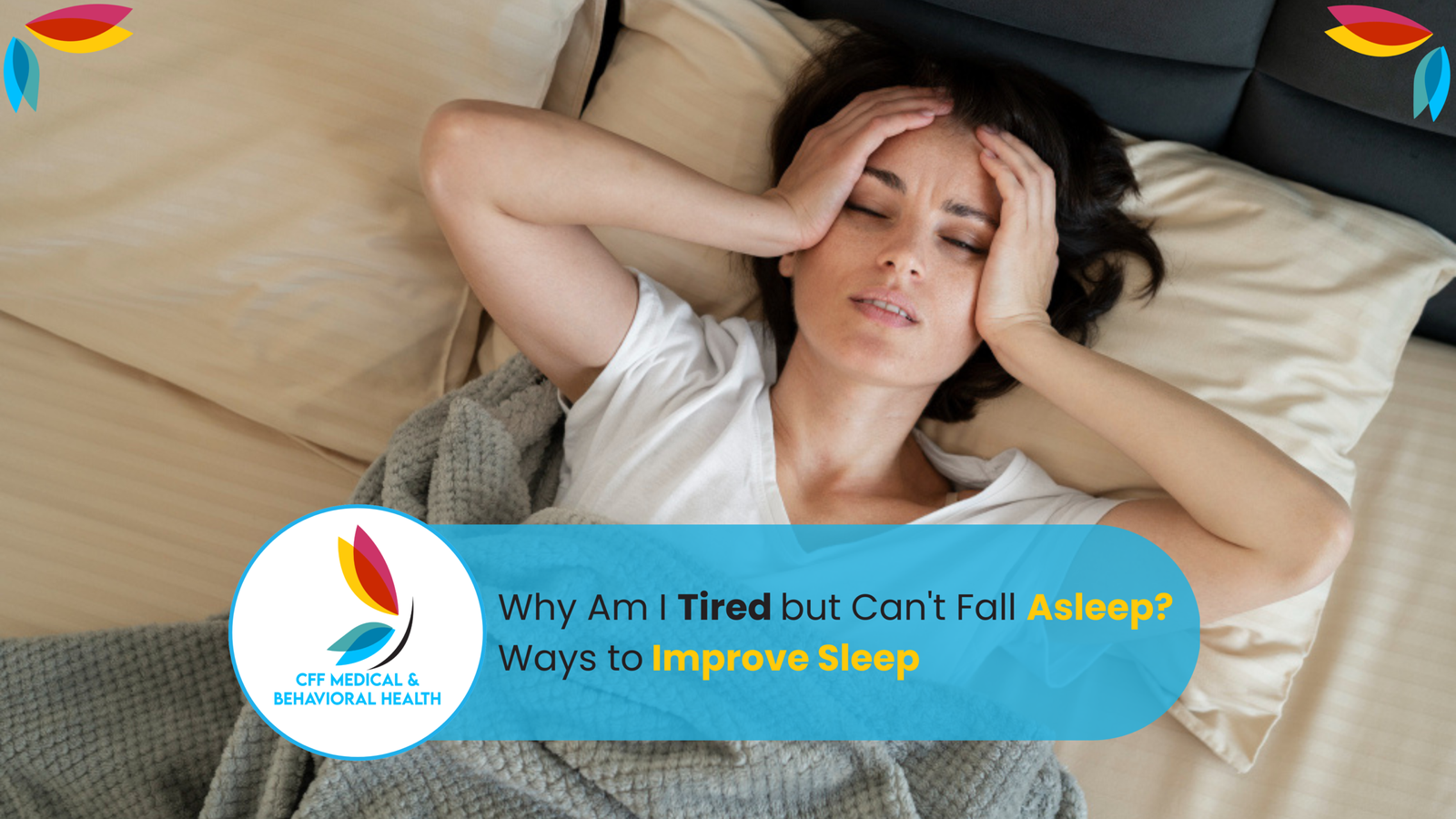
You made it through the whole day half-asleep. Coffee at 2 pm. Eyes are burning by 7 pm. You told yourself you’d be out cold the second you got into bed.
Then you lie down and your brain lit up as if you’d just had a full night’s rest.
That gap between how tired you feel and your actual ability to fall asleep is something what an insomniac knows deeply.
There is a real explanation for it, and more importantly, there are real ways out of it.
Why You Feel Exhausted but Can’t Actually Fall Asleep
Tiredness and sleepiness look the same from the outside but they are genuinely different things.
Tiredness is your body running low on fuel.
Sleepiness is a specific neurological state where your brain has wound down enough to let go.
You can have the first without the second, and that is exactly what happens to millions of people every night.
Your body does not just switch off at bedtime.
It is a slow process: your body temperature decreases, your melatonin rises, and even the alertness part of your brain needs to take a rest.
When that process is not being finished by something, then you are physically exhausted but mentally alert.
Your Stress Response Is Still Running
The cortisol is expected to rise early in the morning and to decline silently during the day.
By evening, it should be low enough that your body can start settling. But when you are under stress, even ordinary stress like a full inbox or a difficult conversation from earlier that day, cortisol does not get that memo. It stays up. Your brain stays in a mode that made sense at 10 am and makes no sense at midnight.
This is the most common answer to what’s keeping you awake. Not insomnia as a medical condition. A nervous system that never got told the day was done.
Anxiety, Depression, ADHD, and PTSD All Affect Sleep Too
The conditions interfere with sleep in certain, varying ways.
Threat-detection is maintained all night by anxiety, and thus the sort of full-body release that sleep demands is nearly impossible.
Depression usually reverses this phenomenon and makes individuals sink into long, heavy sleep that can still leave them drained, or wake them up at 4 am with a heavy chest without means of falling back asleep.
PTSD can make the nighttime feel like a place to survive rather than rest.
ADHD creates a brain that is genuinely not done yet when the rest of the house has gone quiet.
What makes this complicated is that sleep loss makes every one of these conditions worse. And worse mental health makes sleep harder.
That loop is where a lot of people get stuck for years.
The Habits That Pile On
Caffeine drunk after 1 or 2 in the afternoon is still working on your nervous system at bedtime.
That is not opinion, it is how long caffeine actually takes to clear your system.
Alcohol does the opposite of what people think: it may get you to sleep faster but it fragments everything that follows, especially the deep restorative stages.
Spending the last hour of your day scrolling through a phone tells your brain, chemically, that it is still daytime.
An irregular sleep schedule is quietly one of the most underrated causes. When you go to bed at 10 one night and 1 the next, your body never has a fixed target to prepare for.
Sleep stops feeling automatic and starts feeling like something you have to chase.
Does Insomnia Come and Go or Does It Stay?
Insomnia connected to a specific stressor, a hard stretch at work, a medical scare, a loss, often lifts when that stressor does.
Sleep comes back on its own. Most people have been through a version of this.
Chronic insomnia does not work that way. After weeks or months of poor sleep, the brain starts making a different kind of association.
Bed stops being a place where sleep happens and becomes a place where you lie awake feeling frustrated.
That association then keeps the insomnia going independently, even after whatever originally caused it is long gone. You end up dreading bedtime.
The worry about not sleeping becomes its own reason not to sleep. That is the cycle that needs real intervention to break.
What Chronic Poor Sleep Actually Does to You
People underestimate this. Is insomnia harmful? Significantly, and across more parts of your life than you would expect.
The insomnia ability to affect your health goes well beyond daytime tiredness. Severe insomnia increases the chances of anxiety disorders and depression.
It impairs the immune system, alters the hormones that govern hunger and appetite, and after some period, elevates the chances of getting cardiovascular disease and type 2 diabetes.
The emotional regulation goes first: you reach your limit quicker, take longer to get out of frustration and you are responding to things you should not respond to.
What makes this especially hard is that people who have slept badly for a long time often stop noticing how much it is costing them.
The reduced version of themselves starts to feel like just how they are.
Understanding How Sleep Actually Works
What Is Core Sleep?
Core sleep refers to the minimum amount of sleep your body needs to keep basic functions running, somewhere around five to six hours for most adults.
During that window, the brain prioritizes deep slow-wave sleep for physical repair and memory. Those are first in line no matter what.
But surviving on core sleep and actually recovering are very different things.
The sleep beyond that minimum is where emotional resilience, creative thinking, and genuine mental sharpness get built. People who routinely cut sleep feel the difference.
They just often do not connect it to sleep because the decline is gradual.
Why REM Sleep Matters More Than Most People Know
Understanding how to achieve REM sleep changes how you think about your total sleep window. REM is almost entirely concentrated in the later part of the night.
Your first sleep cycle has barely any. By the fourth and fifth cycles it stretches significantly longer.
This is where the emotional experience of the previous day gets processed, where learning converts into long-term memory, and where your brain resets.
Cutting your sleep an hour and a half short does not just mean less rest. It specifically removes most of your REM.
People running a chronic REM deficit often feel emotionally raw, less patient, and mentally slower, even on days when they think they slept reasonably well.
- Keep your full sleep window, not just what you think you need
- Alcohol suppresses REM even when it does not seem to disrupt sleep outwardly
- High stress fragments the lighter sleep stages that lead into REM, so the anxiety piece is not separate from this
The Heavy Sleeper Question
The heavy sleeper meaning is simply that some brains generate more activity during lighter sleep stages that buffer against disturbance. It is a neurological trait. It is not an indicator of sleep quality.
A heavy sleeper can have deeply fragmented sleep architecture and almost no REM and wake up feeling terrible every single morning.
Being hard to wake is not the same as sleeping well.
Ways to Improve Your Sleep
Set a Wake Time and Hold It
Your wake time is what anchors your sleep-wake cycle. Not your bedtime. Pick a time that is realistic and keep it the same every day including weekends.
Over a week or two, your body begins building genuine sleepiness that aligns with your intended bedtime. Sleeping in on weekends resets this and tends to make the week that follows worse.
If you can get outside or near a window within the first 20 to 30 minutes of waking, do it.
Natural light in the morning is one of the strongest signals your body has for keeping the internal clock on time.
The Hour Before Bed Does a Lot of Work
Your ability to fall asleep is largely determined before you get into bed.
Dimming the lights in the evening triggers melatonin production in a way that bright overhead lighting actively prevents.
Stepping away from screens removes the specific wavelength that suppresses melatonin most aggressively.
A large meal late in the evening raises your core temperature and can keep you restless for hours.
The goal is not a rigid ritual. It is simply to lower stimulation gradually so the transition into sleep is not a hard cut from full activity to expected unconsciousness.
Stop Trying to Make Yourself Sleep
Monitoring yourself for signs of drowsiness keeps your brain active. Trying to clear your mind gives your mind something to do.
The approaches that actually work redirect attention rather than force an outcome.
Deliberately running through a sequence of unrelated, low-stakes images, a particular street, a color, or an object you saw years ago, interrupts the loop of analytical thinking without creating more tension around sleep.
Tensing and releasing of the body muscles one by one works out the muscles and diverts the mind out of the thinking process.
Breathing with a long, slow exhale activates the part of your nervous system responsible for rest in a way that is hard to override consciously.
Writing things down before bed, whatever is sitting in the back of your mind, is consistently underestimated.
You are not trying to solve anything. You are just giving your brain permission to stop holding it.
Address What Is Underneath
Sleep hygiene is a support layer, not a solution. In the case of the real cause being anxiety, the anxiety requires some consideration.
And in the case that the sleep problem is associated with depression, PTSD, or ADHD, they must be treated.
Conducting behavioral work regarding sleep and leaving the underlying problem untouched is similar to curing a symptom and claiming it is complete.
When to Seek Professional Help
A practical insomnia test:
Has the sleep difficulty happened three or more nights a week for more than three months?
Is it showing up in how you function during the day?
If both are true, what you are dealing with is chronic insomnia by clinical definition, and self-directed changes are unlikely to be enough on their own.
Cognitive Behavioral Therapy of Insomnia is the best-evidenced treatment of chronic insomnia.
It directly targets the conditioned thought patterns and behaviors keeping the cycle going.
It is always superior to sleep medication in long-term improvement in head-to-head research and is not associated with any dependency.
In cases where anxiety, depression, PTSD, or ADHD are also comorbid, a combination of the sleep work and treatment yields the results that neither method can achieve independently.
Sleep Care at CFF Medical & Behavioral Health
CFF Medical & Behavioral Health in Columbus, Ohio, treats sleep disorders as part of the full mental health picture.
Not as a separate complaint with a separate checklist, but as something connected to everything else that is going on. That is where the real answers tend to live.
By the time you are asleep consistently and waking up feeling like a person again, the goal is for the thing that was actually driving the problem to have been found and addressed.
Every patient starts with a one-hour evaluation for that reason.
Enough time to actually understand what is happening.
Our care includes:
- CBT-I is integrated with treatment for anxiety, depression, PTSD, ADHD, and mood disorders
- Trauma-informed approaches including EMDR for nightmare-related and trauma-driven sleep disruption
- Medication management when clinically appropriate, with a strong lean toward non-habit-forming options
- Telehealth services
- Board-certified providers
Same-day appointments are available. Get in touch today.